A company car park is not the same thing as a garden path. Here, load capacity, durability and a predictable completion date are what matter — the pavement has to carry continuous vehicle traffic for years without rutting or sinking.
Pavement build-up and load capacity of a car park
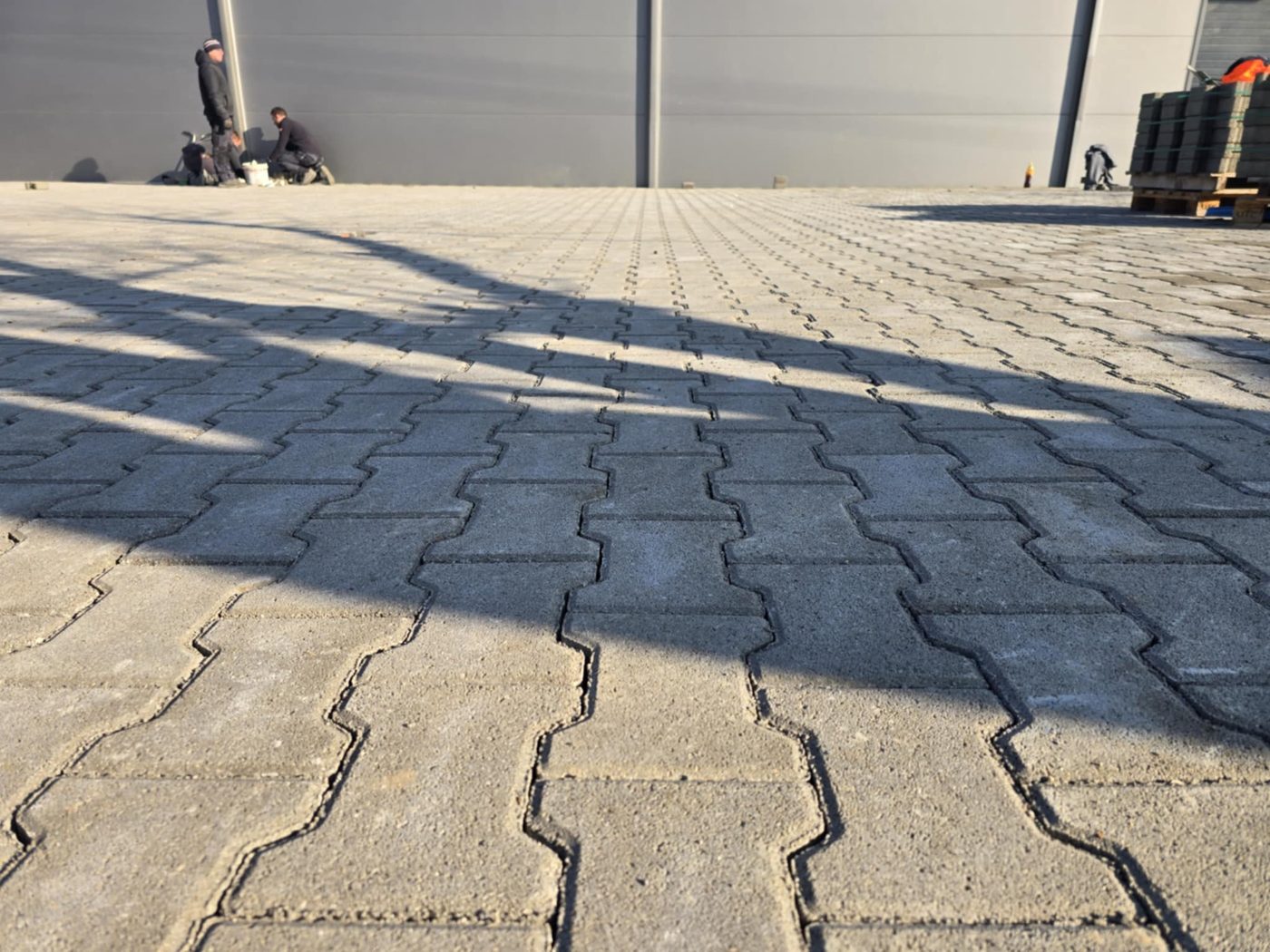
The loading on a car park is far greater than on a private driveway: continuous traffic, heavier vehicles, frequent braking and turning. The structure has to withstand this for years. That calls for thicker pavers (6 cm, and 8 cm in specific zones), a strong, carefully compacted crushed-stone sub-base (zahorra) and, frequently, a cement-treated base (suelo-cemento) as reinforcement. Interlocking blocks resist lateral forces particularly well. The build-up is dimensioned to the Spanish PG-3 specifications and technical recommendations for pavements; you can read more in our article on industrial pavement design.
Programming and a reliable deadline
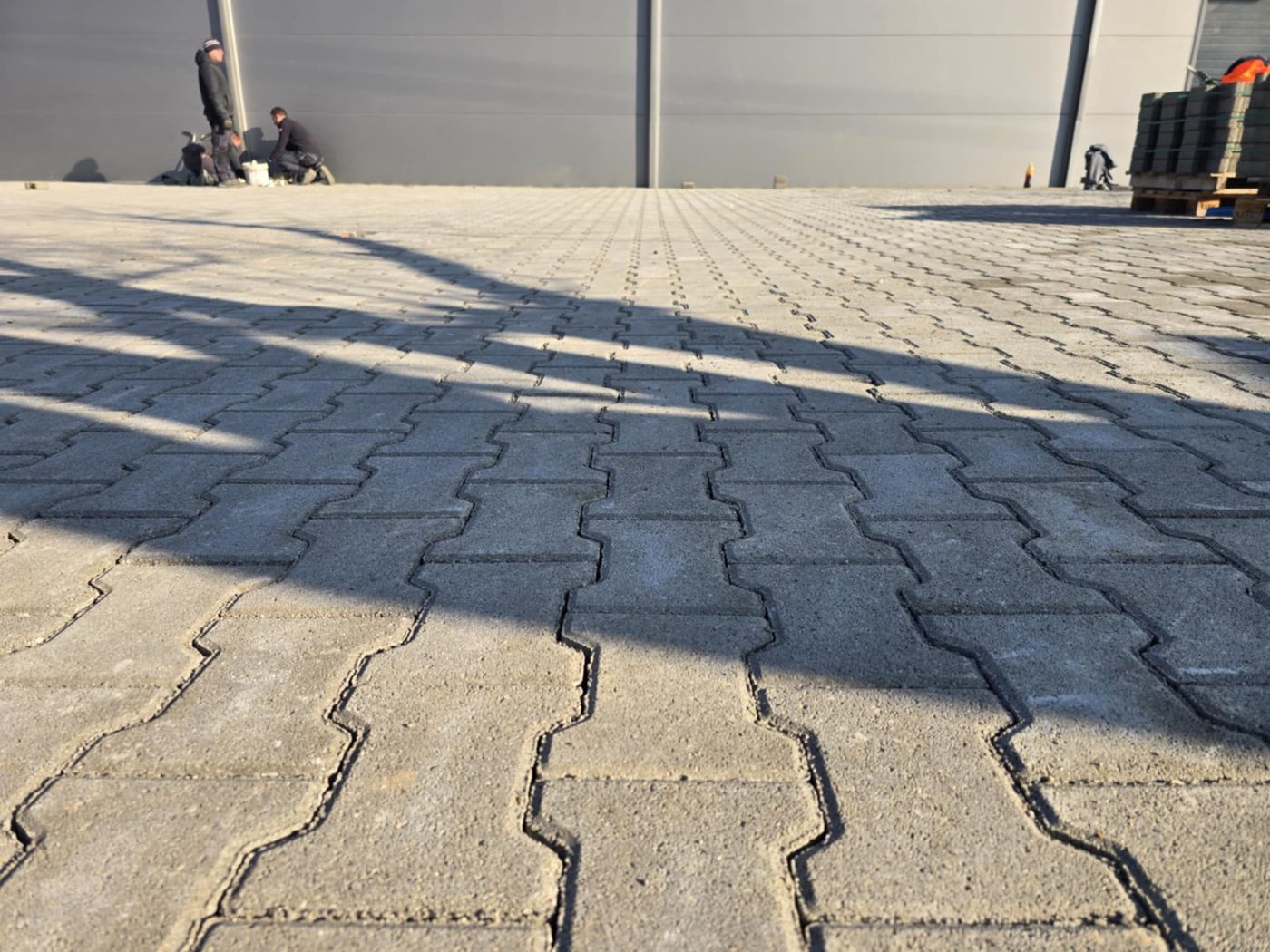
For a business investment, keeping the deadline is a baseline requirement, because losing the car park affects operations. After the site survey we hand over a concrete construction programme that accounts for the area, the pavement build-up and the curing and compaction times of the concrete works. On larger surfaces the work can be phased so that part of the car park stays in service throughout.
Drainage at industrial scale
Large sealed car park surfaces collect a great deal of rainwater, and in the province of Málaga the torrential autumn storms (DANA) can drop enormous volumes within hours. Surface drainage design is therefore a key issue: we carry the water to the discharge point with correct falls, drainage channels and gullies. Standing water means ponding, slip hazards and accelerated deterioration of the pavement.
Why block paving and not asphalt?
Block paving's greatest advantage in car parks is repairability: if a buried utility needs attention or a patch is damaged, the blocks are lifted and relaid — unlike asphalt, which has to be patched. Block paving also looks better, resists deformation — asphalt softens and ruts in the Málaga summer heat — and with permeable options it can be more environmentally friendly too.
In a car park, a predictable deadline and a load-bearing pavement build-up are worth more than looks.
How much does a car park cost to build?
The industrial build-up is thicker and stronger than a residential one, so car park pricing is always individual — it depends on the area, the expected traffic and the pavement build-up. Above roughly 300 m² we always prepare a tailored quotation. For an accurate offer, send us the surface area and the type of traffic at oficina@adoquin.eu, or call +34 613 656 443.
Planning the car park layout
A good company car park is not just load-bearing but well organised: bay dimensions, aisle widths, traffic direction and pedestrian routes all shape its usability. Block paving is an advantage here, because the different zones (bays, aisles, walkways) can be distinguished with different colours or laying patterns, ordering the traffic visually as well — permanently, and without painted markings.
Load zones within the car park
Loading is not uniform within the car park either: where vehicles merely stand, the demand is lower than at the entrances and in the curves, where they brake and turn. In access and manoeuvring zones we use a reinforced build-up and interlocking blocks; in the bays, a more economical one. This differentiated dimensioning optimises cost without sacrificing durability.
Drainage and environmental requirements
Large impermeable surfaces collect significant stormwater that must be discharged in a compliant way. Surface drainage is handled with channels, correct falls and an authorised discharge point; in some cases a hydrocarbon (oil) separator or silt trap may be required. Using permeable pavers reduces run-off, which can be an advantage both environmentally and when dealing with the municipal licence.
Building without stopping operations
At a working site, traffic often cannot simply stop. In those cases we build the car park in phases: we close off one section, build it, hand it over and move to the next. This means a somewhat longer overall programme, but operations continue. The exact phasing plan is agreed after the site survey.
Long-term cost: block paving vs asphalt
Although asphalt's initial cost can sometimes be lower, block paving often works out more economical for car parks in the long run: it does not deform in the summer heat, damaged areas are repaired locally, and when a buried service needs access, it is lifted and reinstated. Over the whole service life that is a substantial saving. For an individual quotation: oficina@adoquin.eu.
Organising traffic with the pavement itself
In a well-designed car park, the pavement itself helps keep traffic in order. Blocks in different colours or patterns permanently mark out bays, aisles and pedestrian routes — no paint, which wears away over time. It is not only tidier but safer: pedestrian and vehicle routes are clearly separated, reducing the risk of accidents.
Accessible parking bays
For company and public-use car parks, regulations may require accessible bays: a wider bay with a transfer zone, a flat, slip-resistant surface and an accessible route to the entrance. Block paving lends itself well to this, because surface flatness and level transitions (dropped kerbs) can be executed precisely. We take these requirements into account at the design stage.
Lighting and infrastructure
When designing the car park, it pays to think ahead about lighting, cameras and possible EV charging points. Their ducting is laid economically during the earthworks phase; doing it later means breaking out the finished pavement. In a well-thought-out car park, the column foundations and cable routes are in place before paving begins.
Maintenance and service life
A company car park is economical when it lasts long and is cheap to maintain. Block paving's advantage is that a damaged zone is repaired locally and the surface is easily kept clean with a sweeper. With a proper sub-base and drainage, you get decades of operation at low maintenance cost. For an individual quotation: oficina@adoquin.eu.
Timeline: how does a car park build proceed?
A company car park build consists of well-programmable phases: survey and design, earthworks and formation trimming, sub-base (crushed stone, cement-treated base) compacted in layers, kerbs, bedding course, block laying, and finally compaction and jointing. Curing times for the concrete works count too. The precise timeline is given after the site survey and, on larger surfaces, can be phased so operations never stop.
A worked example: block paving as a long-term saving
Even where asphalt's initial price per square metre is lower, the whole-life cost often favours block paving. If a utility ends up under the car park, asphalt must be cut open and relaid, whereas pavers are lifted and put back at a fraction of the cost. Summer deformation and patch repairs also tip the balance towards block paving over time.
What should the commissioning business look out for?
For a company car park, ask for an itemised, dimensioned quotation that shows the pavement build-up and its load logic, plus the drainage solution. Agree a predictable deadline and how operations will be maintained (phasing). And ask for a guarantee. A reliable contractor commits to all of this and documents the work. For an individual quotation: oficina@adoquin.eu.
Summary
- A car park's higher loading demands thicker blocks, well-compacted crushed stone and often a cement-treated base.
- Paver colours permanently mark out bays and lanes — no painted lines needed.
- Drainage of the large sealed surface (falls, channels, discharge point) is mandatory.
- Block paving can be lifted and repaired locally — an advantage over asphalt.
- The work can be phased so operations never stop.
Key terms
Load zone: parts of the car park with different loading, which receive different pavement build-ups.
Drainage channel: a grated surface drainage element that carries water to the discharge point.
Frequently asked questions
Will the car park take heavy traffic?
Yes, with proper dimensioning: thick pavers, a strongly compacted crushed-stone sub-base and cement-treated base reinforcement are the key.
How long does a company car park take to build?
The deadline depends on the area and the pavement build-up; after the site survey we provide a concrete timeline, and the work can be phased.
Why is block paving better than asphalt for a car park?
Because it can be lifted and repaired locally, it looks better, and with permeable options it is more environmentally friendly.
Request your industrial quotation: send us the surface area and expected traffic at oficina@adoquin.eu, call +34 613 656 443, or book a free site survey.
Planning a paving project?
Request a free site survey: we measure, advise, and within 1–2 working days you receive a detailed written quote.